ID POV, in essence:
- The universe has countless physical attributes, that all fit together neatly and precisely, to produce planets, life and people.
- The odds of all this working out so well by chance are vastly beyond human comprehension. Thus, the universe had to be intelligently designed.
So...
- If ours is the only universe, then ID apparently has merit.
- If there is an infinitude of universes (eg, chaotic inflation), then ID doesn't have merit, because given infinite chances, sooner/later a universe like ours would pop up.
Originally posted by SurturNot my logic, but this is the argument (afaik). Personally, I'm waiting for the LHC to find one of those compactified dimensons, or for cosmologists to determine what those 'bruise' patterns in the cosmic microwave background mean.
Your logic makes no sense. So because humans can't comprehend the odds of something it must mean the universe was designed intelligently?
As I understand it, there are currently quite a few theoretical models for a multiverse/parallel realities:
http://physics.about.com/od/astronomy/f/ParallelUniverseTypes.htm
I'm not a Christian and Mindship answered your rather question well, but as a mild believer of ID or something akin to ID, I do think it's more likely that there is a greater power and method to the universe than it just being absolutely random chance(s). In the end I ultimately don't know, it's just what I choose to believe as it makes more sense to me.
Narrowing it down to something smaller like 'creation vs evolution', I believe in evolution as the creation story to me is fairy-tale nonsense. But I also wonder if the mechanisms for evolution didn't have someone/thing/power behind it as opposed to more random chance(s).
Originally posted by RobtardFor reasons I've posted many times elsewhere (eg, nature of proof), neither am I convinced that physical reality is all there is. But ID is not the answer, IMHO. It is the physical version of an ontological argument, and I find those lacking as well.
I'm not a Christian and Mindship answered your rather question well, but as a mild believer of ID or something akin to ID, I do think it's more likely that there is a greater power and method to the universe than it just being absolutely random chance(s).
For sure, as I said, in the end I ultimately don't know, just the concept of there being some greater power as opposed to just all randomness makes more sense to me.
The watch argument or even the eye argument are silly to me. Even if evolution were proven to be false, that in of itself does not prove God/ID to be true on that merit alone. Also find the God-of-The-Gaps argument to be faulty.
Originally posted by Mindship
As I understand it, there are currently quite a few theoretical models for a multiverse/parallel realities:
When you have Brian Greene and other popular science writers talking about the multiverse, they're not talking about a requirement for any theoretic model. They're talking about non-scientific interpretations you can make from the various concepts that are introduced in those models.
Originally posted by Robtard
I'm not a Christian and Mindship answered your rather question well, but as a mild believer of ID or something akin to ID, I do think it's more likely that there is a greater power and method to the universe than it just being absolutely random chance(s). In the end I ultimately don't know, it's just what I choose to believe as it makes more sense to me.Narrowing it down to something smaller like 'creation vs evolution', I believe in evolution as the creation story to me is fairy-tale nonsense. But I also wonder if the mechanisms for evolution didn't have someone/thing/power behind it as opposed to more random chance(s).
Originally posted by Astner
No. There are no theoretical models for a multiverse.When you have Brian Greene and other popular science writers talking about the multiverse, they're not talking about a requirement for any theoretic model. They're talking about non-scientific interpretations you can make from the various concepts that are introduced in those models.
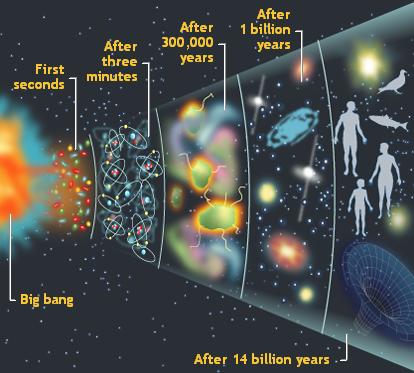
Big Bang theory gives the impression of an intelligent design in the works.
Big Bang process is apparently continuous and leading to creation of new and more advanced/complex stuff with passage of time in the Universe at large.
Have a look:
http://meta-gaia.angelfire.com/big_bang_nageo.jpg
http://www.cosmosup.com/wp-content/uploads/2014/12/BigBang.jpg
http://www.khabdha.org/wp-content/uploads/2011/02/big_bang1.jpg
Originally posted by AstnerClose enough. 😉. They still suggest a far more viable path of investigation than empirically searching for an immaterial superconsciousness.
No. There are no theoretical models for a multiverse.When you have Brian Greene and other popular science writers talking about the multiverse, they're not talking about a requirement for any theoretic model. They're talking about non-scientific interpretations you can make from the various concepts that are introduced in those models.
Originally posted by Van Hohenheim
You state your belief but don't state why.Why do you think think it had an intelligent design? What leads you to think this?
I did actually, here it is again: "In the end I ultimately don't know, it's just what I choose to believe as it makes more sense to me."
I'm not an ID proponent in the sense of the actual ID theory, though I don't think we can call ID a theory.
Originally posted by Van Hohenheim
Those damn string theorists give scientists a bad image.
The main argument for the multiverse—without getting too technical—relates to the Calabi-Yau space through which the extra dimensions in m-theory are conjectured to be compactified. The problem with the moduli spaces of the Calabi-Yau space are solved with the superpotentials generated by two flux vacua leaving holes that correspond to a number different vacuums each of which is supposed to be a universe.
Once again, it's a very specific—and I'd argue: wishful—interpretation of a solution to a problem in a model that does not allow for predictions.
Originally posted by Mindship
Close enough. 😉. They still suggest a far more viable path of investigation than empirically searching for an immaterial superconsciousness.