Today our Sun is said to be shifting from the astrological sign of Pisces into that of Aquarius, as the precessional movement of the Poles makes the backround of stars move by a tiny distance, relative to the Earth, across the sky.
The signs each take around 2,160 years to shift from one constellation to the other (30 degrees), meaning that they shift around one degree every 72 years.
The eighteenth dynasty existed during the precessional period of Aries, the ram. At that time astrologers would say that "the Sun was in the sign of Aries."
Prior to this, more than 4,165 years ago, the Sun was in the sign of Taurus, the bull, and at that time the bull was worshipped by the Egyptians at Memphis during the early dynasty periods, which became associated with Osiris (this is known from objects found in the Serapeum at Saqqara).
British astronomer Norman Lockyer demonstrated the astronomical significance of the alignment of temples at the Karnak complex. On the day of the summer solstice, Sunlight penetrated along the axis of the temple of Amun-Ra to the sanctuary at the far end, illuminating a statue of Ra. He noticed that star temples, used as observatories by the Ancient Egyptians, were built to observe the movement of rising stars, just before dawn.
Lockyer calculated that the layout of temples appeared to mark time in accordance with the precessional period. A survey embracing the chronological development and construction of the Karnak complex showed the successive temples had been realigned four times, corresponding to precessional movements of the stars, thereby meeting the demands of the ever-changing sky.
The evidence is clear. The Egyptians from the earliest times were preoccupied with the movements of stars and planets.
In The Orion Mystery Robert Bauval showed that hitherto unexplored shafts from the King's Chamber and the Queen's Chamber in the Great Pyramid of Cheops, at Giza, were aligned to point to the stars of Orion and Sirius.
The northern shafts similarly suggested purposeful alignments; one from the Queen's Chamber points directly at Beta Ursa Minor, which was associated with cosmic regeneration to the Egyptians and the immortality of the Soul, while the northern shaft from the King's Chamber points towards Alpha Draconis in the constellation of the dragon, which the Egyptians associated with fertility.
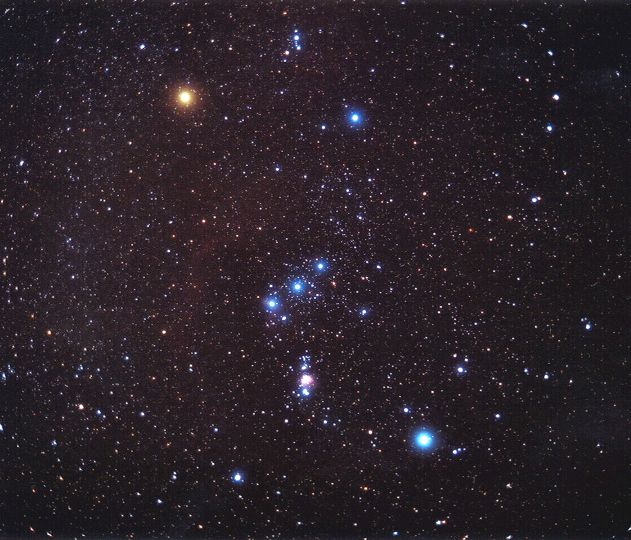
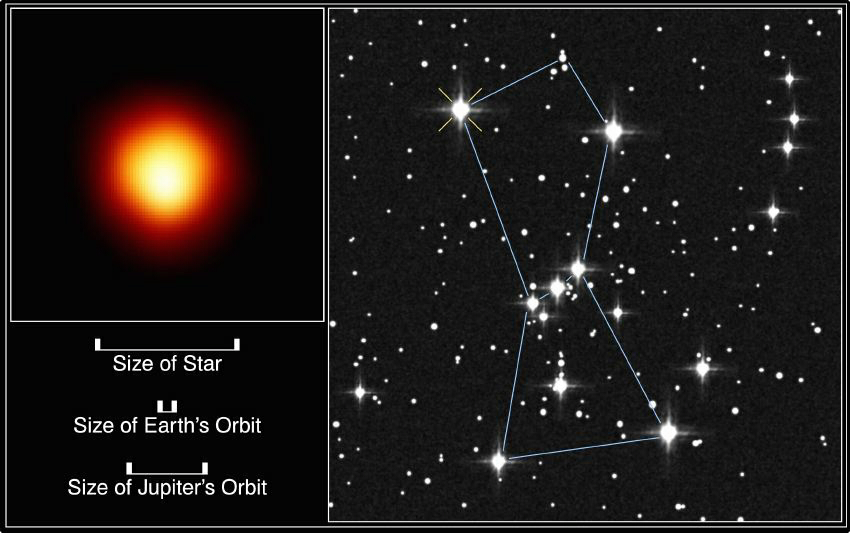
Here are some pictures of the star system Orion which meant ALOT to the Ancient Egyptians, so much so that they aligned some of their pyramids with it:
http://www.cadas.net/images/orion.jpg
http://www.astromax.com/con-page/images/orion852.jpg
http://antwrp.gsfc.nasa.gov/apod/image/0302/orion_spinelli_c1.jpg
http://nssdc.gsfc.nasa.gov/image/astro/hst_betelgeuse.jpg
http://www.physics.brocku.ca/doc/astronomy/Stars+Solar_System/NEBULAE/orion.trapez.jpg
http://lerch.no-ip.com/atm/Images/Chiefland_03/Orion_early/_Orion.jpg
http://www.physics.brocku.ca/doc/astronomy/Stars+Solar_System/NEBULAE/orion_btc_big.jpg
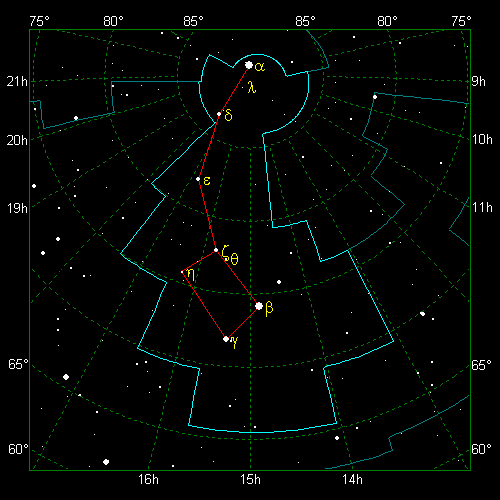
Here is a picture of the Beta Ursa Minor star system which the northern shaft of the Queen's Chamber in the Great Pyramid of Cheops, at Giza, points to:
Here are some pictures of the system of Alpha Draconis which the northern shaft of the King's Chamber in the Great Pyramid of Cheops at Giza points to:
http://dibonsmith.com/dra_1.gif
http://www.wingmakers.co.nz/CM%20Draconis%20Planetary%20System.jpg
So here we have the civilization of Ancient Egypt that worshipped the Sun, which they knew was connected with fertility in female Human Beings. Modern science 5,000 years later, using the latest in space-age exploration, has only just reached the same conclusions.
The Sun really does control fertility hormones in females through regulation of the 28-day menstrual cycle. And the Moon plays a part in the process as well.
The Ancient Egyptians worshipped the Sun as the "feathered snake", and again modern man has only just reached the same conclusion, because the "feathered snake" represents the 11-year Sunspot cycle carried on top of the 'nuetral warp' of the Sun's magnetic field.
The Ancient Egyptians also understood complex astronomical relationships, aligning their temples to meet the precessional cycle, reflecting the precession of the heavens on the Earth.
They even carved the Zodiac into many of their temples (such as Dendera), aligned their collosal pyramids with star patterns in the sky (such as at Giza) and, using their architectural pointers, showed us the places in the sky that they were fond of.
The evidence suggests that these people were much cleverer than was originally thought. The intellectual ascent of man has not been linear.
In Egypt we see the presence of a higher intelligence on two distinct occasions in history, both of which coincide with the worship of the Sun itself: the fourth-dynasty pyramid age and the eighteenth dynasty of Tutankhamun 1,000 years later.
Both of these occasions saw a burst of creative accomplishment that saturated Egypt, technologically, scientifically and artistically, the likes of which the World has never seen since, apart from the miraculous achievements of the Sun-worshipping Maya in Mexico.
Towards the end of the Ancient Egyptian's civilization, things started to go down hill, and much of if not almost all of it was related to the Sun.
The Greek dramatist Sophocles (in Oedipus Tyrannus) wrote of diasters and plagues that befell Thebes, which Marie Delcourt (in Sterilites mysterieuses et naissances malefiques dans l'antiquite classique, 1938) says was an attempt to show that 'plague' referred to sterility, or barrennes, of women, accompanied by barrenness of cattle and land.
For the Ancient Egyptians, it had become too late. The end had already begun: graphs of the Sun's radiation at around this time (1350 BC), show that a massive Sunspot minimum occurred at that time, causing infertility in females. This was accompanied, at the same time, by a mini-ice age, resulting in less evaporation of waters from the oceans, reduced rainfall globally, and reduced rainfall, particularly in Africa, the source of the Nile, leading to drought and crop failure.
When precipitation does occur, colder temperatures in the upper atmosphere lead to an increase in hail formation at higher altitudes. At the same time an increase in ionising radiation allows more harmful radiation to enter the Earth's atmosphere, resulting in genetic mutation of gestating foetuses and increased infant mortality.
All of the above from the last post is mentioned both in the Bible AND in an Ancient Egyptian papyrus of the sage Ipuwer:
The river is blood. If one drinks it, one rejects [it] and thirsts for water (Egyptian papyrus 2:10)
...And all the waters that were in the river were turned to blood. And the fish that were in the river died; and the river stank, and the Egyptians could not drink the water of the river (Exodus vii, 20, 21)
Plague is throughout the land. Blood is everywhere (Egyptian papyrus 2:6)
...And there was blood throughout all the land of Egypt (Exodus vii, 7:21)
All animals, their hearts weep, cattle moan because of the state of the land (Egyptian papyrus 5:5)
Behold, the land of the Lord is upon thy cattle which is in the field, upon the horses, upon the asses, upon the camels, upon the oxen, and upon the sheep: there shall be a very grievous murrain (Exodus ix, 3)
Gates, columns and walls are consumed by fire (Egyptian papyrus 2:10)
...And the Lord sent thunder and hail, and the fire ran along upon the ground; and the Lord rained hail upon the land of Egypt (Exodus ix, 23)
That has perished which yesterday was seen, and the land is left over to its weakness like the cutting of the flax (Egyptian papyrus 4:14)
...And the hail smote every herb of the field, and brake every tree of the field (Exodus ix, 25)
The children of princes are dashed against walls. The once prayed for children are now laid on the high ground (Egyptian papyrus 4:3)
....And it came to pass, that at midnight the Lord smote all the first-born in the land of Egypt, from the firstborn of Pharaoh that sat on his throne unto the firstborn of the captive that was in the dungeon (Exodus xii, 29)
Groaning is throughout the land, mingled with lamentations (Egyptian papyrus 3:14); he who places his brother in the land is everywhere...(Egyptian papyrus 2:13)
...And there was a great cry in Egypt, for there was not a house where there was not one dead (Exodus xii, 30)
The Ancient Egyptians were able to calculate the Sunspot cycle, which is a theory that our present astronomers barely know! They were somehow able to do this by means of accurate observations of the sky, consistently carried out over thousands of years and with the help of very advanced mathematics. How highly developed must their mathematical knowledge have been? Very highly indeed. Much higher than we thought up to now!
To describe the Sunspot cycle theory in mathematical language, you need to know an incredible amount of information about space geometry (the volume and surface of spheres, for example), the calculation of ellipses, and have a great number of other complex arithmetical skills. And yet, somehow the Ancient Egyptians were able to do it. Their Egyptian papyri prove that they had this knowledge.
What is just as sensational though, is that the Ancient Egyptians must have also known integral and differential equations; or otherwise it would have been just about impossible to calculate the Sunspot cycle!
And where did all this knowledge come from? It came from their ancestors, the inhabitants of Aha-Men-Ptah (Atlantis). We can be sure of that thanks to the translation of their story through their ancient hieroglyphs done by people like the Egyptologist Albert Slosman. They encoded these stories into their structures such as in the Temples of Dendera, Edfu, and Esna.
Their stories point to the legacy of a lost civilization that had disappeared during a catastrophic disaster.
Here are some pictures of the Ancient Egyptian temple of Dendera:
http://www.touregypt.net/featurestories/dendera32.jpg
http://i-cias.com/egypt/photos/dendera17.jpg
http://www.planetanimals.com/egypt/dendera-temple.jpg
http://i-cias.com/egypt/photos/dendera02.jpg
http://www.jmundyphotography.com/egypt/images/Abydos-entrance.jpg
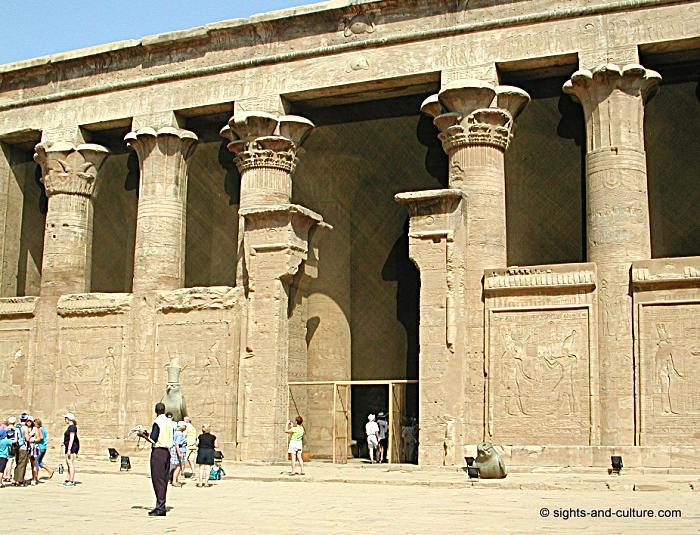
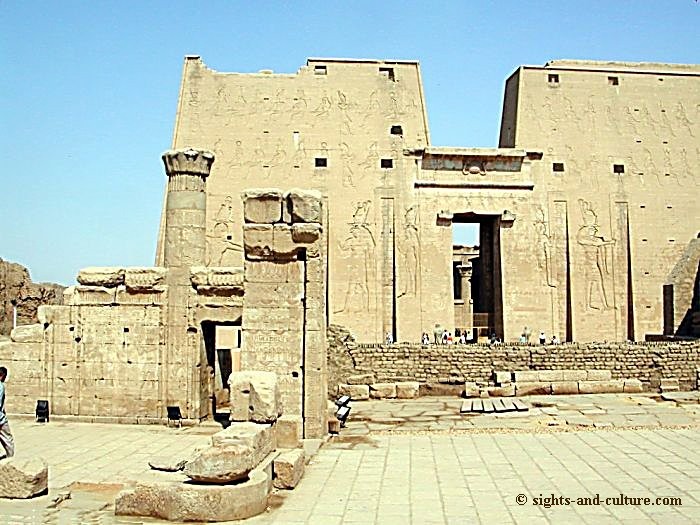
Here are some pictures of the Ancient Egyptian temple of Edfu:
http://www.sights-and-culture.com/Egypt/Edfu-horus-temple-6840.jpg
http://www.sights-and-culture.com/Egypt/Edfu-horus-temple-pylon-6854.jpg
http://people.brandeis.edu/~smooha/egypt/luxor%20to%20aswan/Edfu%20Temple%20gate.jpg
http://www.affordablehousinginstitute.org/blogs/us/Edfu_temple_small.jpg
http://bryan.goulstone.org/Edfu/slides/04%20EDFU%20-%20Temple.jpg
Here are some pictures of the Ancient Egyptian temple of Esna:
http://petrov.com.ua/Egypt/images/Esna_Khnum_Temple_2.jpg
http://petrov.com.ua/Egypt/images/Esna_Khnum_Temple_1.jpg
http://www.aegypten-hotels.com/aegypten/luxor/esna-temple.JPG
http://lexicorient.com/egypt/photos/esna_exterior01.jpg
http://image56.webshots.com/56/3/32/76/524833276bOBWfJ_fs.jpg