World War 3 - New World Order - Pole Shift - Age of Peace (2006-2012)

Started by NuclearWinter89 pages

KING TUT:

Nebkheperure Tutankhamun (alternately spelled with Tuten-, -amen, -amon; lack of written vowels in Egyptian allows for different transliterations) *tuwt-ʕankh-yamân was a Pharaoh of the Eighteenth dynasty (ruled 1333 BC – 1324 BC), during the period of Egyptian history known as the New Kingdom. His original name, Tutankhaten, meant "Living Image of Aten", while Tutankhamun meant "Living Image of Amun". He is possibly also the Nibhurrereya of the Amarna letters.

He is also significant as a figure who managed the beginning of the transition from the heretical Atenism of his predecessors Akhenaten and Smenkhkare back to the familiar Egyptian religion.

As Tutankhamun began his reign at age 9, his vizier and eventual successor Ay was probably making most of the important political decisions during Tutankhamun's reign. Nonetheless, Tutankhamun is, in modern times, one of the most famous of the Pharaohs, and the only one to have a nickname in popular culture ("King Tut"😉.

The 1923 discovery by Howard Carter of Tutankhamun's nearly intact tomb (subsequently designated KV62) received worldwide press coverage and sparked a renewed public interest in Ancient Egypt, of which Tutankhamun remains the popular face.

A hundred and forty-two objects had been buried in the tomb of King Tut. They were interlaced and woven in the layers of bandages wrapped around the mummified body.

King Tut himself was object number 144. Here again, this number is mentioned in the Book of Revelation (144,000), and also in Ancient Mayan Culture, and it was an important number for the survivors of Atlantis as well.

The Book of Revelation in the Bible details the vision that came on St John, a disciple of Christ:

"I saw four angels standing on the four corners of the earth, holding
the four winds of the earth, that the wind should not blow on the
earth or the sea, nor any tree. And I saw another angel ascending
from the east, having the seal of the living God, and he cried with
a loud voice to the four angels, to whom it was given to hurt the
earth and the sea, saying, 'Hurt not the earth, neither the sea, nor
the trees, until we have sealed the servants of our God on their
foreheads. And I heard the number of them which were sealed:
and there were sealed an hundred and forty and four thousand of
all the tribes of the children of Israel. (Revelation vii, 1-4)

The number 144 (followed by zeros) appears to be unique to the Ancients of the World and it goes all the way back to the survivors of Aha-Men-Ptah, the lost continent of Atlantis.

Also buried in the tomb of King Tut was a special golden mask. The mask was made from solid gold inlaid with opaque blue glass, imitating lapis lazuli. The mask was made from two pieces of beaten gold sheets, accurate to within one thousandth of an inch in thickness across the entire surface. It measures 54 centimetres (approximately 1 foot 10 inches) high and weighs 10.23 kilogrammes (22 1/2 pounds).

The official interpretation of the significance of the piece simply states that the mask portrays Tutankhamun as Osiris, wearing the nemes, the headcloth of royalty, with a pigtail down the back. The forehead carries the vulture and cobra symbols of Upper and Lower Egypt.

But there is much more to the the mask than this. Because upon close examination of the mask, from the rear, follows the outline of a Human male symbol representing fertility. The pigtail becomes the central vein along the shaft of the symbol. The rear of the top of the symbol is covered with (26) rays of the Sun (the duration of the equatorial magnetic field of the Sun, on the Sun's surface, in days), linking the Sun with Tutankhamun, and both again, with fertility.

The pigtail also resembles the tail of a bee, which is an insect known to be controlled by the Sun's radiation.

From the front elevation, the number of horizontal bands corresponds with the rotation of the Sun's equatorial magnetic field seen from the Earth, the 28-day fertility cycle.

Here are some pictures of the golden mask, also called "The golden deathmask", that was found buried in King Tut's tomb:

http://www.egyptiandreams.co.uk/keywords/tutankhamun/king%20tut%20death%20mask%20tutankhamun.php

http://news.bbc.co.uk/olmedia/1735000/images/_1736285_mask150.jpg

http://touregypt.net/museum/tutl18.jpg

http://content.answers.com/main/content/wp/en-commons/thumb/4/4a/250px-Tutanchamun_Maske.jpg

http://www.egyptreservation.com/tutmask_lg.gif

King Tut's mummy was covered with objects, primarily pieces of jewellery, including necklaces, pendants, rings, amulets, corselets, collars, vultures, serpents and brooches.

Two daggers were also found strategically positioned; both of them had sheaths of gold but only one of the blades was made of gold, the other one was made of iron.

The dagger made of iron is extremely important, because before the iron blade was disovered in King Tut's tomb, many historians insisted that iron had never been used, or even discovered, in Egypt. But now we know differently.

The iron dagger is also important because it is magnetic and could be used as a compass for traveling.

This is just another discovery that proves that historians are not always right and that there is much much more for us to learn about the Ancient Egyptians than many of us might currently think.

Here is a picture of the golden dagger that was found buried in King Tut's tomb:

http://touregypt.net/marketplace/tomb/burial/tutdagger_b.jpg

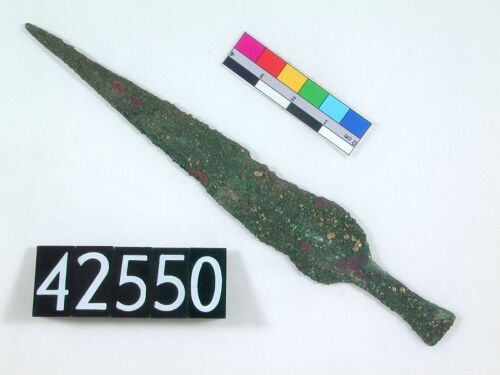
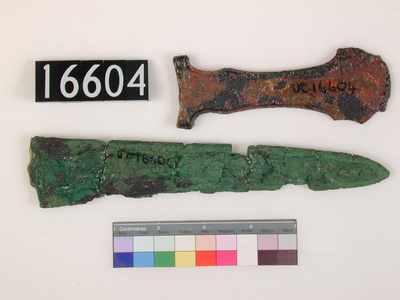
Here are some pictures similar to what King Tut's Iron Dagger looks like but without the impressive hilt, ect.:

http://www.digitalegypt.ucl.ac.uk/tools/archive/uc42550.jpg

http://www.digitalegypt.ucl.ac.uk/qau/archive/uc16604.jpg

Below is a report about and a picture of an Iron plate that was discovered in the Great Pyramid of Ancient Egypt.

This report and picture not only proves that the Ancient Egyptians knew about Iron, but it also proves that they used it.

Aside from King Tut's Iron dagger, this is just more evidence that most of all of the historians were wrong about how sophisticated the Ancient Egyptians really were.

Here is the report with the picture included:

http://www.catchpenny.org/iron.html

Here is another site that is deticated to the fact that the Ancient Egyptians knew of the existence of Iron. It gets into facts about iron in other parts of history as well:

http://www.gizagrid.com/body_egyptian_iron.html

Also buried in King Tut's tomb was a special Scarab Brooch that contains important symbolic significance.

Upon closer inspection of the brooch, it was found that there are three parallel bars at the tail end of the scarabm that are not proportionately spaced. The distance from the outer edges of the bars to the centre line of the crescent disc measures the same, but the distance between the inside edge of each bar varies to the centre line.

Despite this, the brooch itself appears to contain symmetry between it's left and right halves, and indeed, there are 183 inlaid stones in each wing, 366 in total, representing the number of days in a leap year. But closer inspection of the stones reveals that symmetry does not exist between the arrays of stones in opposing wings.

The next point to note is the number of stones contained between gaps in the feathers on each wing. These have been labelled a-g (left wing) and a-f (right wing) and, additionally, r-z on the left and r-z on the right. The total number of stones now amounts to 397.

The disc of the brooch contains 360 degrees. The total number of inlaid stones amounts to 397; 397-360 = 37, and 37 is an astronomically significant number because it is the number of the duration, in days, of one revolution of the Sun's polar magnetic field. Here, the 360-degree movement of the Earth around the Sun is emphasised, together with the revolutionary period of the Sun's polar cap.
It is the movement of the cap, in relation to the movement of the Sun's equator, which causes radiation of the Solar wind, which impinges on the Earth.

The encoding of these numbers into the Scarab Brooch shows us again how smart these people were and how advanced was the level of mathematics that the Ancient Egyptians had actually reached.

The Ancient Scarab Brooch from King Tut's tomb tells us many things about their level of knowledge. It also contains the following encoded information:

1. The name of Tutankhamun, Neb-khepru-Re.

2. The number of stones in the feathers adds up to 366, the number of days in one leap year.

3. That the rotational period of the Sun's polar cap amounts to 37 days.

4. That magnetic interaction takes place between the Sun and the Earth.

5. That the Sun emits particles, the solar wind, which bombard the Earth, causing distortion to the Earth's magnetic shield, the magnetosphere.

Here is a picture of the cleverly encoded Scarab Brooch that was discovered in King Tut's tomb:

http://voanews.com/english/images/Pectoral_210.jpg

The last item that I'm going to post about that was also found in King Tut's tomb was a rare complex beaded necklace. It was found in a jumbled bundle on the floor of the Antechamber together with a cache of finger-rings threaded along a slim tubular roll of fabric. These were thought to have been stolen from the Burial Chamber and discarded by fleeing robbers during their hasty exit from the tomb.

The six-tiered necklace clearly resembles rays of the Sun. The fastening clasp consists of two ingots adorned with solar discs. One of the ingots is missing a solar disc bead. This ingot, like the other, should carry 14 beads, but because one stone is missing, it carries only 13.

Both of those numbers are astronomically significant. 13 is the number of half the rotational duration of the Sun's equatorial magnetic field (measured on the surface of the Sun), and 14 is the number of half the duration of the Sun's magnetic field, measured and viewed from the Earth.

The cache of finger-rings found with the necklace amounts to an invitation to 'count' using our fingers. Counting the beads from the neck edge outwards.

Upon closer inspection of the necklace, one realizes that once again the Ancient Egyptians have encoded information in numbers. Rows 1 and 2 of the necklace both add up to 13. When these two rows are added you get the number 26, which is the number of the rotational period, in days, of the Sun's equatorial magnetic field (as measured on the Sun's surface).

Row 3 adds up to 37 beads, which represents the rotational period of the Sun's polar magnetic field, in days (as measured on the Sun's surface).

Row 4 and 5 again add up to the number 26, the number of the rotational period, in days, of the Sun's equatorial magnetic field (as measured on the Sun's surface).

Row 6 adds up to 110.

The total number of beads on the necklace adds up to 397. When you subtract row 3 (37) from the total number of beads on the necklace (397), you again get the number 360 just like the number from the Scarab Brooch, which again, represents the 360-degree rotation of the solar polar field every 37 days.

So the significance of the necklace is extremely important, because it contains the following facts which again show proof of the Ancient Egyptian's supreme knowledge of astronomy:

1. There are 397 full beads on the necklace, which, like the number 397 in the Scarab Brooch, explain that the rotational duration of the Sun's pole is 37 days (the Sun's pole rotates 360 degrees in 37 days).

2. The number of beads in different rows of the necklace reveals that the rotational duration of the Sun's equator is 26 days, and that the rotational duration of the poles is 37 days (as measured on the Sun's surface).

3. The number of solar discs on the necklace, featured in the two ingots, contains the rotation rates of the Sun's equator measured on the Sun, which is 26 days, and again from the Earth, which is 28 days.

The total number of pieces that make up the necklace as a whole is 400. When you multiply the total number of pieces by the number 360 which is encoded into the necklace, you get the number 144,000.

144,000 is significant because again it is the same number that can be found in the legend of the survivors of Atlantis, in Ancient Egyptian culture, in Ancient Mayan culture, and in the Book of Revelation from the Holy Bible.

By multiplying the odd row 6 which contains the number 110, by the number of the row itself, 6, you get the number 666. Which again, refers to the Book of Revelation from the Bible.

Here is a picture of the famous Beaded Necklace (also known as the "Sun Ray Collar"😉 that was found in King Tut's tomb:

http://www.touregypt.net/museum/collar.jpg

Both the Scarab Brooch and the Beaded Necklace that were found in King Tut's tomb reveal that the Ancient Egyptians knew about the super-science of the Sun.

It is also now known that the Ancient Egyptians knew about the fact that the Sun's radiation was causing infertility on the Earth around that period of time that King Tut was in power.

The Ancient Egyptians derived their strength from their faith. It was for them a useful system of belief, because it gave them goals and rules from which they could build up intense experiences. To them, life consisted of service, and all their doings were focused on the life awaiting them after death.

This efficient system ruled their whole life; it gave purpose to it and preserved them from chaotic ideas. Their scientific knowledge about man and the Universe revealed to them the relation between Humanity and its destiny. Through this understanding they had superior insight into the origins of social mechanisms, their feelings, hopes and fears.

This belief system pushed them in the direction of meaningful goals from which they got their strength as well. They culturally expressed this in their legends and buildings.

It it now up to us to bring back this long lost knowledge. Because then, like them, we will be able to reunite ourselves with our surroundings and the meaning of life.

Part of the Ancient Egyptian's faith, based on the catastrophe cycles, acknowledges the laws of nature. It pushes our Spiritual energy in the direction of meaningful targets, because the belief system is based on the scientific knowledge of man and the Universe and the expected "End" of our World AS WE KNOW IT.

It develops as if it were an integrated interpretation of all earlier developed knowledge related to Humanity and its inescapable destiny. It is useless to connect our dreams and desires to nature without bearing in mind its laws. When we acknowledge the limitations of our civilization and its inevitable end, and again accept a humble place in the Universe, we will start to feel like the progidal son or daughter who finally comes home after years of wandering.

If the aim of Humanity is united with these values and experiences, the problem of the meaning of Life will be solved. Billions of people will then experience the forthcoming catastrophe that will soon shake our Earth to it's foundations as a liberation, and will sacrifice themselves voluntarily to a higher purpose: the continued existence of Humanity, and the rediscovery of an overpowering God image.