Originally posted by Galan007
Yes.From the Beyond Realm, the Marvel multiverse was literally microbial/germ-esque to Beyonder... Which makes the 'pre-retcon' Beyond Realm about equal to DC's Monitor Sphere, in terms of scale.
microbial? I thought that beyond realm only made the multiverse a drop in comparison. scans?
Originally posted by alekj019It's from an interview with Jim Shooter in Marvel Age #27:
microbial? I thought that beyond realm only made the multiverse a drop in comparison. scans?
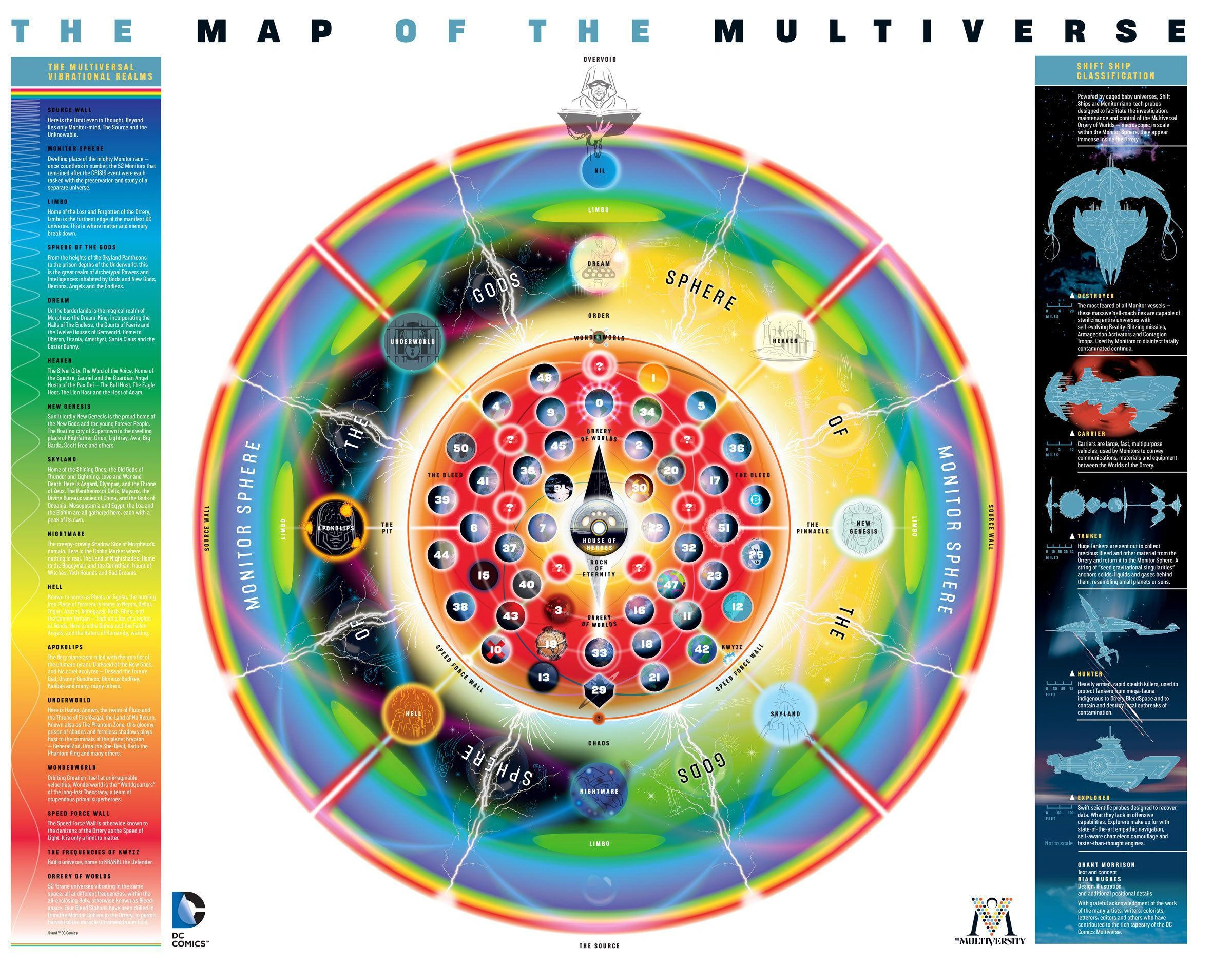
...Which is pretty much identical to how DC creation is perceived from the Monitor Sphere:
https://i.imgur.com/p8NECKP.jpg
So yeah, the 'pre-retcon' Beyond realm ~ the Monitor Sphere in terms of scale.
Originally posted by Galan007
It's from an interview with Jim Shooter in Marvel Age #27:
https://i.imgur.com/gLSOOhF.jpg
*Pertinent text highlighted....Which is pretty much identical to how DC creation is perceived from the Monitor Sphere:
https://i.imgur.com/p8NECKP.jpgSo yeah, the 'pre-retcon' Beyond realm ~ the Monitor Sphere in terms of scale.
Overvoid>>absolute infinity>>Nil>>Monitor sphere>>infinity>>Limbo>>infinity>>sphere of gods>>infinity>>DC creation
isn't it?
I don't understand what put beyond realm above the sphere of gods.
Originally posted by CatL18For me, it's the description. From the vantage point/scale of the Beyond realm, the mainstream Marvel multiverse was perceived as "paramecia swimming in a drop of water."
I don't understand what put beyond realm above the sphere of gods.
From the vantage point/scale of the Monitor Sphere, the mainstream DC multiverse was perceived as "germs."
...Though I agree that an argument could be made that the God Sphere scales close to the Beyond realm. 👆
Originally posted by Genii96They really aren't, though.
as I've always said both companies are basically equal in size.
Where sheer size/scale is concerned, the classic Beyond realm is the vastest realm that Marvel has to offer -- nothing exceeds it(unless you know of a greater dimension in Marvel..?) And per description, the classic Beyond realm is about equal in size/scale to the Monitor Sphere in DC.
Difference is: DC has dimensions that that infinitely out-scale the Monitor Sphere... Which means they infinitely out-scale the Beyond realm as well.
Originally posted by Magnon
I used those same values. If we assume the average solar luminosity is L = 4*10^26 J/s and the lifetime of a (yellow) sun is T = 10^10 years = 3.2*10^17 s, then the total amount of radiative heat transfer (Q) equalsQ = 10^44 J (rounded to one significant figure)
This is the value I used. The panel mentioned "heat" (J), not "power" (J/s) or "flux" or anything else involving a rate of change. Thus the most literal interpretation for the expression "heat of a sun" is the TOTAL amount of radiative heat available from the sun.
It doesn't matter whether or not you hold you hand over a flame for a second or ten seconds, in both cases the flame will have heated your and you would've felt it.
A more reasonable assumption would be that Superman experienced the heating of ten billion suns during the moment he was exposed to Mandrakk's blast.
Another issue is of course the degree exposure, because technically even we're heated by the sun during a winter morning when it peaks over the horizon. But given the context I'd think it's closer to the billion suns' solar luminosity even though it's the theoretical ceiling of what can be reasonably assumed.
The last issue is Cosmic Armor specific heat capacity, which you assumed to be around solid steal. The issue with this is that the specific heat capacity of an object varies with temperature, and particularly in the shift of aggregation states. For instance, stars have a negative heat capacity because of the fusion process.
But, like I said, these are minor issues. Because my point is that substantiates the idea that Monitor Armor Superman is finite, and that natural forces can cause him harm.
I'm putting an emphasis on this because of a good point made in Star Trek, where Q claimed to have traveled back to the Big Bang and compared it to a fireworks show. It's clear from that, that hypernovae, gamma-ray bursts, or any naturally occurring phenomenon isn't enough to make a Q flinch.
I think downplaying CAS with metaphorical statement is futile.
Because both CAS and Mandrakk are not material but pure idea powerd by metafictional narrative.
They are not harmed by any material or conceptual attack because they operate on metafictional plane of existence where almost every cosmology in DC is mere fiction.
Even if some character can harm CAS with multiversal omnipotent attack, CAS can easily adapt and become Infinitely stronger because the story of Superman demands it.
It is the fact confirmed in actual story.
Originally posted by CatL18
I think downplaying CAS with metaphorical statement is futile. Because both CAS and Mandrakk are not material but pure idea powerd by metafictional narrative.
Originally posted by CatL18
They are not harmed by any material or conceptual attack because they operate on metafictional plane of existence where almost every cosmology in DC is mere fiction.
And I think you're misunderstanding metafictional element of the story. Mandrakk was going to destroy the multiverse, by drinking the Bleed (the space in-between the 52 universes) because he's a vampire.
Originally posted by CatL18
Even if some character can harm CAS with multiversal omnipotent attack, CAS can easily adapt and become Infinitely stronger because the story of Superman demands it.
It is the fact confirmed in actual story.
To say that, because of that they endlessly adapt is a gross exaggeration. And let's not forget that the Monitor Armor broke down after the fight. Contradicting this idea.
And the idea that you need to be nigh-omnipotent to fight the Monitor Armor doesn't make sense either because Mandrakk wasn't even ultimately defeated by the Monitor Armor, but by the collective effort of the heroes of the Multiverse.
Originally posted by Astner
[B]You're free to think that. But we still need something tangible in order to compare these characters to other cosmic characters. And while you can dismiss "the heat of ten billions suns" as metaphorical, you can also accept it as being literal.
Originally posted by Astner
The Monitor and the Anti-Monitor were harmed by physical attacks despite being from the Monitor Sphere.
Originally posted by Astner
And I think you're misunderstanding metafictional element of the story. Mandrakk was going to destroy the multiverse, by drinking the Bleed (the space in-between the 52 universes) because he's a vampire.
"Wonder Woman gets a emomentf in Final Crisis #7 but by that time, Mandrakk has sucked all the life out of the story!"
Originally posted by Astner
To say that, because of that they endlessly adapt is a gross exaggeration. And let's not forget that the Monitor Armor broke down after the fight. Contradicting this idea.
Originally posted by Astner
And the idea that you need to be nigh-omnipotent to fight the Monitor Armor doesn't make sense either because Mandrakk wasn't even ultimately defeated by the Monitor Armor, but by the collective effort of the heroes of the Multiverse.
"Wonder Woman gets a emomentf in Final Crisis #7 but by that time, Mandrakk has sucked all the life out of the story!"
It is for Miracle Machine's metafictional power of "Happy Ending" that Superheroes could defeat Ogama.
So,Your downplay doesn't make sense.
There was two Mandrakks in that story.
Dax Novu had become powerful by eating the stories of the multiverse unchecked.
Ogama was powerful, but not even a fraction of the way to where Novu was and even then it took another monitor, heaven, hell, all the supermen of the multiverse and all the other characters they rescued from time/space to put him down. A team so powerful it could be assembled only once against the absolute enemy.
The cosmic armor story of Superman Beyond in the highest plane was a meta for the entire story overall, and all the stories overall. Wherein. hope, represented by Superman in these stories, will always prevail in the end.
Originally posted by Galan007They really aren't, though.
Where sheer size/scale is concerned, the classic Beyond realm is the vastest realm that Marvel has to offer -- nothing exceeds it(unless you know of a greater dimension in Marvel..?) And per description, the classic Beyond realm is about equal in size/scale to the Monitor Sphere in DC.
Difference is: DC has dimensions that that infinitely out-scale the Monitor Sphere... Which means they infinitely out-scale the Beyond realm as well. [/B]
Except the problem is you see the marvel multiverses and structures contained within eternity as all 3-D, which makes you think the beyond realm, which I quite bigger, is not impressive, simply because the monitor sphere saw the 3D inhabitants as germs from the perspective of their realm. Marvel Introduced both a 4D and even a 5D realm space way back, and even dimensions above the concept of time as well, which would be Inbetween 4D and 5D if you were to fit them into a cosmology scale. Then the superflow is above all these, and the neutral zone above even that, with the far shore coming after that, with the next known realm being the beyond realm with the realms inbetwen the two 'unkown', From the perspective of one in the beyond realm, all of these are microbial
Marvel writers don't explore these other numbered dimensions nor do they structure their dimensions according to dimensional number as good as DC does, their cosmology structuring coming in old comics, I don't know if you guys still accept old comics here
And as for higher realms, yes, the house of ideas should be well above the beyond realm
But NVM, like I said, I believe both companies are equally Large