Originally posted by 2damnloud
Magneto on the brink of DEATH courtesy of Storm😱
Why would you post that? If anything thats a good showing for Magneto not storm.
Basically Magneto is being bothered/attacked by the rest of the x-men when storm comes and tries to zap him. He basically shows her what a punk she is by absorbing her lightning.
Storm then goes for a tornado. Now Magneto mentions that the tornado put a strain on him but he ALWAYS mention what a strain things are to him (the writers do it to add to the dramatic element, it would be boring for magneto to easily handle storm and the x-men). Yet magneto almost always manages to muster enough strength/power to come out on top.
In this case while storm was busy trying to take mags out he simply knocked colossus into her. What happened to her great multitasking abilites? Colossus is a BIG projectile and she couldnt even react to him cause she was busy.
Bottom line magneto owned storm there and he owns her ass now.
Originally posted by Swanky-Tuna
"I don't think he'll fling it fast enough" (probably not exact wording.)
http://img130.imageshack.us/my.php?image=classicxmen01808xy8.jpg
4000 miles in less then half an hour. So at worst 4000 miles in half an hour. Therefore 8000 miles per hour. That's fast.
Originally posted by 2damnloud
Anyway, the phrase "Entire core" contradicts "Ambient".
But the ambient energy does come from all over the entire core. And again panel art contradicts your meaning.
Originally posted by 2damnloud
Nope, I said not with the force of thousands of pounds of falling debris.
I'ts the Milky Way, not the core. The galactic core is at the center of our Galaxy, as well as every galaxy. Do some research please😊
Originally posted by Swanky-Tuna
Is she in the core in the scan?
Yep. She enters the core through a nebula(Pink purple cloud).
Fixed the scans:
http://img122.imageshack.us/img122/2924/xmen198301uncannyxmen16as2.jpg
http://img212.imageshack.us/img212/6445/stormandthegalaticcore15zq.jpg
Originally posted by ExodusCloak
http://img130.imageshack.us/my.php?image=classicxmen01808xy8.jpgBut the ambient energy does come from all over the entire core. And again panel art contradicts your meaning.
Not all over, "Entire" core.
This may very well turn into a Shaman/ Blizzard, Johnny/structural support battle of semantics and arguing wishful thinking in total abandonment of canon. 💃
So sad 😆
Originally posted by 2damnloud
Not all over, "Entire" core.This may very well turn into a Shaman/ Blizzard, Johnny/structural support battle of semantics and arguing wishful thinking in total abandonment of canon. 💃
So sad 😆
Except panel art and the fact that Storms range canon as you would put it contradict your explanation. As well as the energy output of the entire feat.
Alot goes on in the Galactice core. I like how it said, it was as simple as drawing energy from the earth to manipulate the weather😱
What have I been saying all ALONG🙄
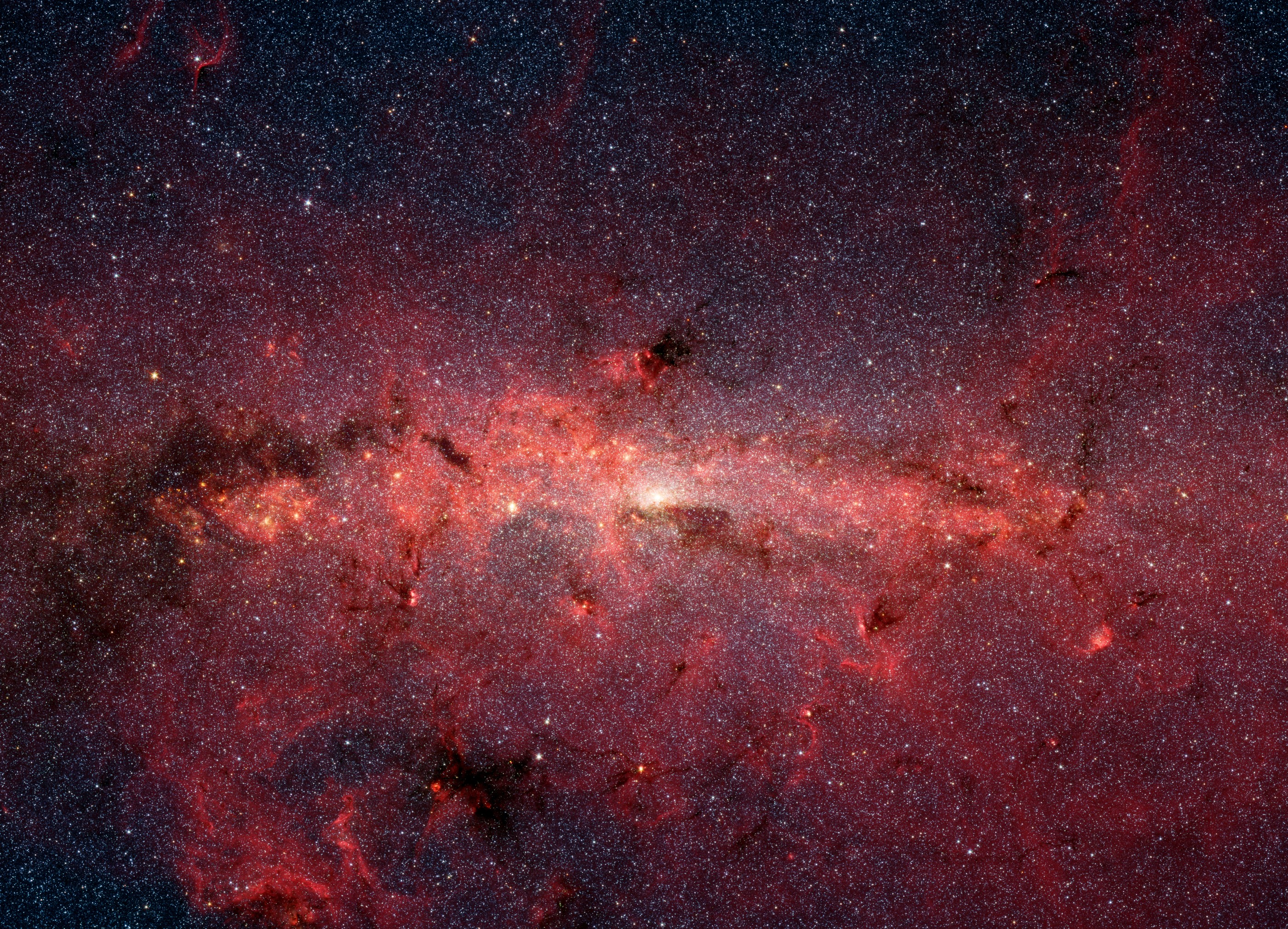
http://antwrp.gsfc.nasa.gov/apod/image/0702/gcenter_spitzer_f40.jpg
Explanation: The center of our Milky Way Galaxy is hidden from the prying eyes of optical telescopes by clouds of obscuring dust and gas. But in this stunning vista, the Spitzer Space Telescope's infrared cameras, penetrate much of the dust revealing the stars of the crowded galactic center region. A mosaic of many smaller snapshots, the detailed, false-color image shows older, cool stars in bluish hues. Reddish glowing dust clouds are associated with young, hot stars in stellar nurseries. The galactic center lies some 26,000 light-years away, toward the constellation Sagittarius. At that distance, this picture spans about 900 light-years.
http://antwrp.gsfc.nasa.gov/apod/ap070114.html
Explanation: Why are these stars moving so fast? Shown above is a time-lapse movie in infrared light detailing how stars in the central light-year of our Galaxy have moved over the past eight years. The yellow mark at the image center represents the location of a peculiar radio source named Sgr A*. If these fast stars are held to the Galactic Center by gravity, then the central object exerting this gravity must be both compact and massive. Analysis of the stellar motions indicates that over one million times the mass of our Sun is somehow confined to a region less than a fifth of a light-year across. Astronomers interpret these observations as strong evidence that the center of our Galaxy is home to a very massive black hole.
http://antwrp.gsfc.nasa.gov/apod/ap060810.html
Explanation: If you had x-ray vision, the central regions of our Galaxy would not be hidden from view by cosmic dust clouds. Instead, the Milky Way toward Sagittarius might look something like this. Pleasing to look at, the gorgeous false-color representation of x-ray data from the Chandra Observatory shows high energies in blue, medium in green, and low energy x-rays in red. The mosaic spans about 130 light-years at the 26,000 light-year distance of the Galactic Center. It reveals massive, x-ray emitting star clusters in a crowded environment. In particular, the Galactic Center cluster and the enormous black hole Sagittarius A* are within the bright region near the bottom. Two other star clusters, the Arches, and the Quintuplet lie near the top. Cluster interactions with dense molecular clouds in the region may produce some of the diffuse emission detected in the Chandra x-ray view.
http://antwrp.gsfc.nasa.gov/apod/ap060729.html
Explanation: What do you call a group of black holes ... a flock, a brace, a swarm? Monitoring a region around the center of our Galaxy, astronomers have indeed found evidence for a surprisingly large number of variable x-ray sources - likely black holes or neutron stars in binary star systems - swarming around the Milky Way's own central supermassive black hole. Chandra Observatory combined x-ray image data from their monitoring program is shown above, with four variable sources circled and labeled A-D. While four sources may not make a swarm, these all lie within only three light-years of the central supermassive black hole known as Sgr A* (the bright source just above C). Their detection implies that a much larger concentration of black hole systems is present. Repeated gravitational interactions with other stars are thought to cause the black hole systems to spiral inward toward the Galactic Center region.
Go here for more http://antwrp.gsfc.nasa.gov/cgi-bin/apod/apod_search?galactic+center
Does anybody else agree with me when I say what they say would make way more sense if they replaced "Storm" with "Binary"?
Originally posted by 2damnloud
I'ts the Milky Way, not the core. The galactic core is at the center of our Galaxy, as well as every galaxy. Do some research please😊
The center of our Milky Way Galaxy is hidden from the prying eyes of optical telescopes by clouds of obscuring dust and gas.
So would it be safe to say the core cannot be seen from the outside just as the rest of the milky way cannot be seen from the inside? Or is it conveniently one way?
Originally posted by Swanky-Tuna
Does anybody else agree with me when I say what they say would make way more sense if they replaced "Storm" with "Binary"?The center of our Milky Way Galaxy is hidden from the prying eyes of optical telescopes by clouds of obscuring dust and gas.
So would it be safe to say the core cannot be seen from the outside just as the rest of the milky way cannot be seen from the inside? Or is it conveniently one way?
But in this stunning vista, the Spitzer Space Telescope's infrared cameras, penetrate much of the dust revealing the stars of the crowded galactic center region 😊